
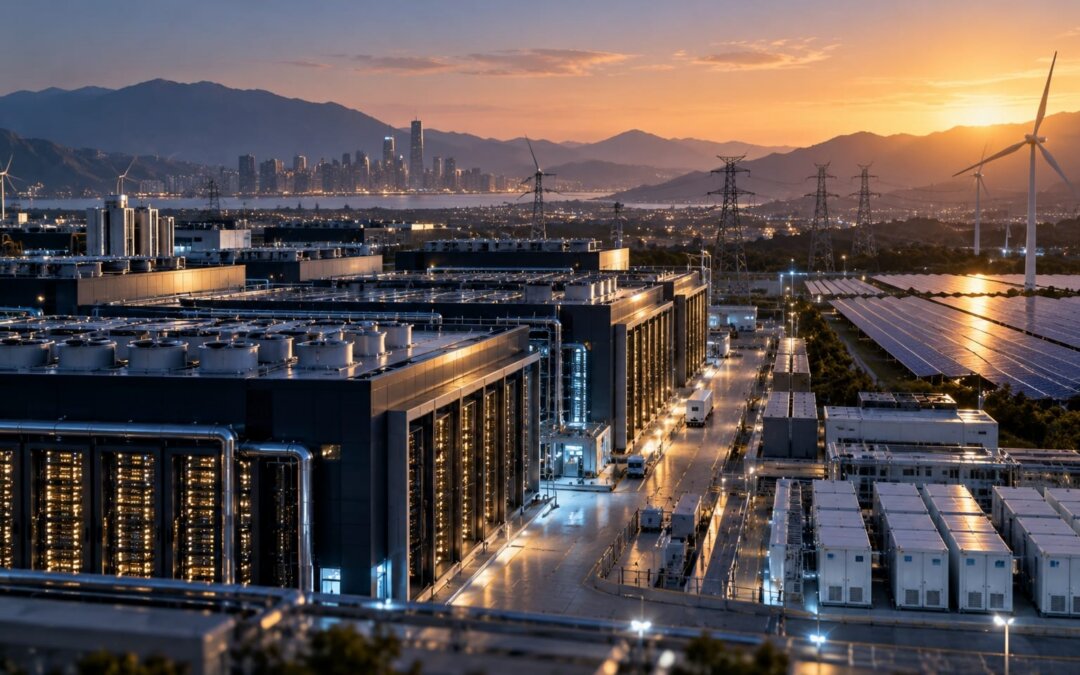
For much of the last twenty years, technology competition was primarily a software competition.
Companies built social networks, search engines, mobile applications, digital marketplaces and cloud platforms.
A small team with a good idea could build a product and reach millions of people without constructing a factory or owning much physical infrastructure.
Artificial intelligence is changing that equation.
The companies competing at the frontier of AI need chips, data centers, electricity, cooling systems, high-speed networks and access to increasingly specialized manufacturing.
Governments are responding by investing in semiconductor production, energy systems and domestic computing capacity.
The global technology race is becoming increasingly physical.
Software Now Depends on Enormous Machines
AI appears to users as software.
You type a question into a screen and receive an answer.
Behind that simple interaction is an extraordinary amount of infrastructure.
Advanced models are trained across clusters containing thousands of specialized processors.
The processors require high-bandwidth memory.
They communicate over specialized networks.
They operate inside data centers drawing enormous amounts of electricity.
As models become larger and AI usage expands, the amount of physical infrastructure grows.
Alibaba recently announced plans to increase its data-center capacity to approximately 20 gigawatts by 2032 as part of its broader AI expansion.
American technology companies are making similarly large investments.
This changes what it means to compete in technology.
Chips Are Becoming Strategic Assets
Semiconductors sit near the center of the change.
Advanced AI processors are difficult to manufacture and depend on an unusually concentrated supply chain.
Nvidia designs many of the world’s leading AI processors.
TSMC manufactures advanced chips in Taiwan.
ASML produces critical lithography systems in Europe.
Specialized companies provide memory, chemicals, packaging and manufacturing equipment.
The result is a supply chain that is both global and strategically sensitive.
Governments increasingly view access to advanced chips as a national economic issue.
The United States has restricted China’s access to some AI processors and manufacturing technologies.
China is investing heavily in domestic alternatives.
The competition now involves not only software innovation but the industrial capacity required to manufacture the hardware underneath it.
Electricity Is Part of Technology Policy
AI is also connecting technology policy with energy policy.
Data centers consume large amounts of electricity.
Building more computing capacity therefore requires more generation, transmission lines, transformers and substations.
This means regions with abundant and reliable electricity may gain an advantage in attracting AI infrastructure.
The relationship works in both directions.
Technology companies are increasingly signing long-term power contracts and investing in energy projects.
Governments are evaluating whether their grids can handle rapid data-center growth.
Suddenly, decisions about electricity infrastructure can influence where advanced AI systems are built.
That is a major change from the software era.
A mobile application could be launched almost anywhere.
A gigawatt-scale AI data center cannot.
Manufacturing Is Back in the Conversation
The shift toward physical infrastructure extends beyond semiconductors.
Batteries, electrical equipment, robots and advanced materials all depend on manufacturing capacity.
China spent decades developing dense industrial supply chains.
That has become a significant advantage in areas such as batteries, solar energy and electric vehicles.
A recent example comes from U.S. battery startup EnerVenue.
The company had originally planned a factory in Kentucky but ultimately built its first commercial factory in Changzhou, China. Its CEO cited China’s engineering talent, supplier network and lower production costs as important factors.
The story demonstrates why rebuilding industrial capacity can be difficult.
A factory is not an isolated building.
It depends on nearby suppliers, engineers, transportation systems, skilled workers and specialized equipment.
Infrastructure creates ecosystems.
Critical Minerals Are Technology Infrastructure Too
Many advanced technologies begin with raw materials.
Lithium, nickel, cobalt, copper, graphite and rare-earth elements are essential to batteries, electronics and energy systems.
Countries and companies are therefore becoming more interested in where those materials originate and how they are processed.
In September 2026, battery recycling company Nth Cycle announced a $1 billion agreement with Glencore involving lithium and other minerals recovered from recycled batteries.
India’s Lohum is simultaneously looking to acquire nickel mines in Indonesia and the Philippines while developing overseas lithium resources.
These are not traditional software-industry concerns.
They illustrate how deeply the technology sector is becoming connected to materials, manufacturing and geopolitics.
Infrastructure Can Become a Competitive Advantage
Infrastructure creates barriers to entry.
A software company can sometimes develop a competing product relatively quickly.
Building an advanced semiconductor fabrication facility can cost tens of billions of dollars and take years.
Building an electricity grid takes even longer.
Developing a domestic supply chain for critical minerals may take decades.
This gives countries with established infrastructure significant advantages.
It also explains why governments increasingly support semiconductor plants, battery factories and energy projects with public incentives.
Technology is no longer viewed only as a private business sector.
It is increasingly treated as strategic industrial capacity.
The Systems Remain Connected
It would be easy to assume that the global technology industry is splitting neatly into separate American and Chinese systems.
Reality is more complicated.
Capital continues to move across borders.
Companies still depend on international customers and suppliers.
Investors continue to participate in both markets.
Reuters recently described investors as effectively playing both sides of the U.S.-China AI divide, even as both countries attempt to build more independent technology ecosystems.
That is not surprising.
The current technology system was built through decades of globalization.
Separating it completely would be extremely expensive.
The more realistic trend may be selective independence.
Countries will try to control the technologies they consider most strategic while continuing to trade in areas where cooperation remains economically useful.
Technology Is Becoming Physical Again
The original personal-computer revolution was deeply connected to hardware.
Then the internet and mobile eras made technology feel increasingly weightless.
Software businesses could scale with relatively little physical investment.
Artificial intelligence is reversing part of that trend.
The leading technology companies are again spending enormous amounts of money on buildings, chips, electrical systems and industrial equipment.
Governments are again discussing factories, energy security and raw materials.
Engineers are confronting problems involving cooling, power density and manufacturing.
The digital economy still depends on software.
But the ability to build that software increasingly depends on physical resources.
The next global technology leaders may therefore be determined not only by who writes the best code.
They may also be determined by who can manufacture the chips, generate the electricity, secure the materials and construct the infrastructure required to make that code useful.