
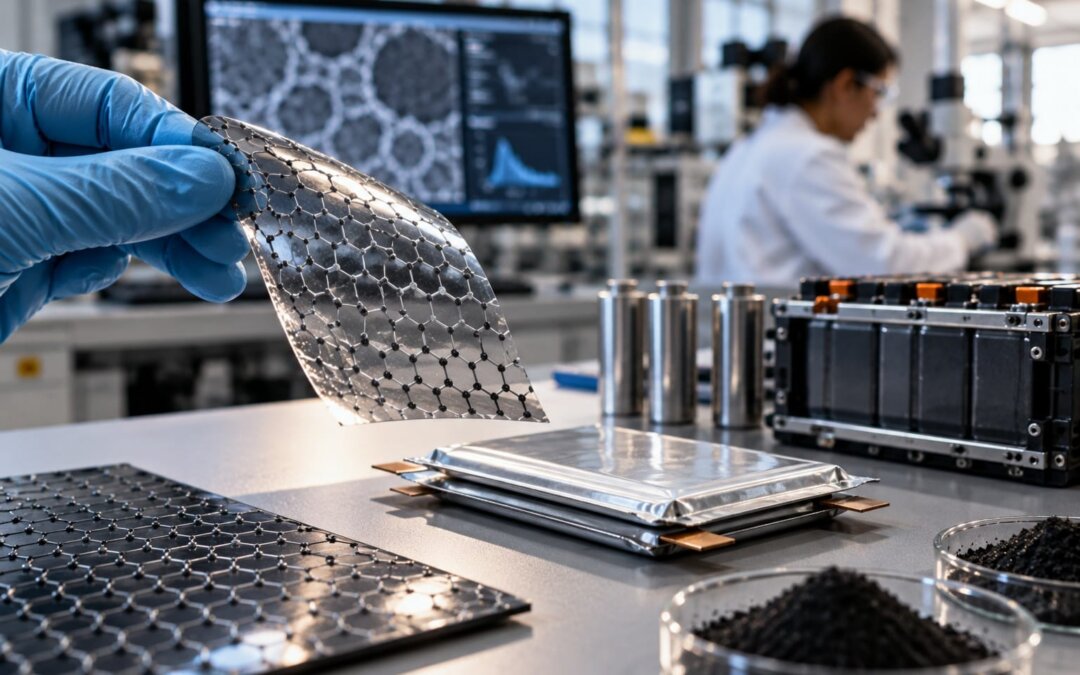
Graphene has spent much of the last two decades surrounded by enormous expectations.
The material is extremely strong, electrically conductive, lightweight and only one atom thick.
Those properties have inspired potential applications ranging from electronics and sensors to aerospace and medical technology.
Energy storage remains one of the most interesting possibilities.
Modern batteries face competing demands.
We want them to store more energy, charge faster, last longer, remain safe and cost less.
Improving one of those characteristics can make another more difficult.
Graphene may help address some of these limitations.
But probably not in the way early predictions suggested.
The future of graphene in batteries may involve improving other materials rather than replacing them.
Why Graphene Looks Attractive
Batteries depend on moving electrons and ions efficiently.
Graphene is an excellent electrical conductor.
It also has an extremely high theoretical surface area.
Those characteristics can be useful inside electrodes.
A conductive graphene network can potentially help electrons move more efficiently through a battery.
Its structure can also create pathways for ions.
Graphene can provide mechanical support for materials that expand and contract during repeated charging cycles.
These capabilities make it interesting across several battery chemistries.
A July 2026 review examined graphene applications in lithium-ion, lithium-sulfur, lithium-oxygen, sodium-ion and metal-air batteries, along with fuel cells and solar-energy systems.
The range of applications is unusually broad.
That is also part of the challenge.
There is no single “graphene battery.”
Improving Existing Batteries
One of the most practical roles for graphene may be as an additive.
Battery electrodes frequently contain active materials that store energy plus other components that help conduct electricity or maintain structure.
Graphene can potentially improve those supporting functions.
Consider silicon anodes.
Silicon can theoretically store considerably more lithium than conventional graphite.
The problem is that silicon expands dramatically when it absorbs lithium.
Repeated expansion and contraction can damage the electrode.
Graphene structures can potentially help provide mechanical support and maintain electrical connections as the silicon changes volume.
Researchers are exploring similar hybrid structures across multiple battery chemistries.
The objective is not necessarily to make graphene the primary energy-storage material.
It is to use graphene where its conductivity, flexibility and surface area solve a specific engineering problem.
Sodium Could Become More Important
Lithium dominates rechargeable batteries today.
But sodium-ion batteries are receiving increasing attention.
Sodium is abundant and relatively inexpensive.
Its chemistry could make it attractive for applications where cost matters more than maximum energy density, particularly stationary energy storage.
Solid-state sodium batteries are also being investigated.
A March 2026 review described anode-free solid-state sodium batteries as a potentially important route toward higher-energy sodium storage while noting major challenges involving electrolytes, interfaces and sodium deposition.
Graphene and related carbon materials could potentially help manage conductivity and electrode structure in these systems.
Again, the role is complementary.
Graphene becomes part of a materials architecture rather than the entire battery.
Supercapacitors Are Another Opportunity
Batteries are not the only way to store energy.
Supercapacitors can charge and discharge much more quickly than conventional batteries.
They generally store less total energy, but they can deliver high power and survive large numbers of cycles.
Graphene’s surface area and conductivity make it particularly attractive for supercapacitors.
Researchers have explored graphene-based electrodes capable of storing charge across very large surfaces.
Laser-induced graphene is one increasingly interesting manufacturing technique.
A laser can convert certain carbon-rich materials directly into porous graphene structures.
Recent 2026 research reviews describe applications for laser-induced graphene in supercapacitors, batteries and other energy systems.
The manufacturing method is appealing because it could potentially create patterned electrodes directly on a material.
That may eventually reduce some processing complexity.
Manufacturing Has Always Been the Problem
Graphene performs extremely well in controlled laboratory conditions.
Industry needs something different.
Manufacturers need tons of material that behaves consistently.
They need predictable quality.
They need supply chains.
Most importantly, the improvement must justify the cost.
Graphene can behave very differently depending on how it is produced.
Graphene nanoplatelets, graphene oxide, reduced graphene oxide and large sheets grown using chemical vapor deposition all have different properties and prices.
The graphene best suited for a semiconductor may not be the graphene needed inside a battery.
This is why scalable manufacturing remains central to commercialization.
A recent review of graphene production concluded that advances in scalable synthesis are improving its industrial prospects, but economics and quality control remain important limitations.
Energy Storage Is Not One Problem
It is also useful to remember that there is no single energy-storage market.
A smartphone battery needs high energy density in a very small space.
An electric vehicle needs range, fast charging, long life and safety.
A grid battery may prioritize low cost and thousands of cycles over weight.
An aircraft might value energy density more than almost anything else.
Different battery technologies will therefore win in different applications.
Graphene may become valuable in some and unnecessary in others.
That is normal.
Successful materials are often invisible components rather than complete products.
Graphene Is Moving Toward Engineering
The most interesting development in graphene today may be the transition from asking what the material can theoretically do to asking what it can economically improve.
That is a much more demanding question.
The scientific case for graphene is already strong.
Its conductivity, mechanical properties and surface chemistry are well established.
Now engineers need to determine where adding graphene provides enough performance improvement to justify additional manufacturing complexity.
Energy storage offers several possibilities.
It could improve conductivity.
It could stabilize electrodes.
It could support fast charging.
It could help create flexible batteries and high-power supercapacitors.
But graphene is unlikely to magically replace lithium-ion batteries.
Its more realistic role may be more important.
It may become one of the materials that makes the next generation of batteries better.
And in a world increasingly dependent on electric vehicles, renewable energy, portable electronics and AI infrastructure, even incremental improvements in energy storage can have enormous consequences.