
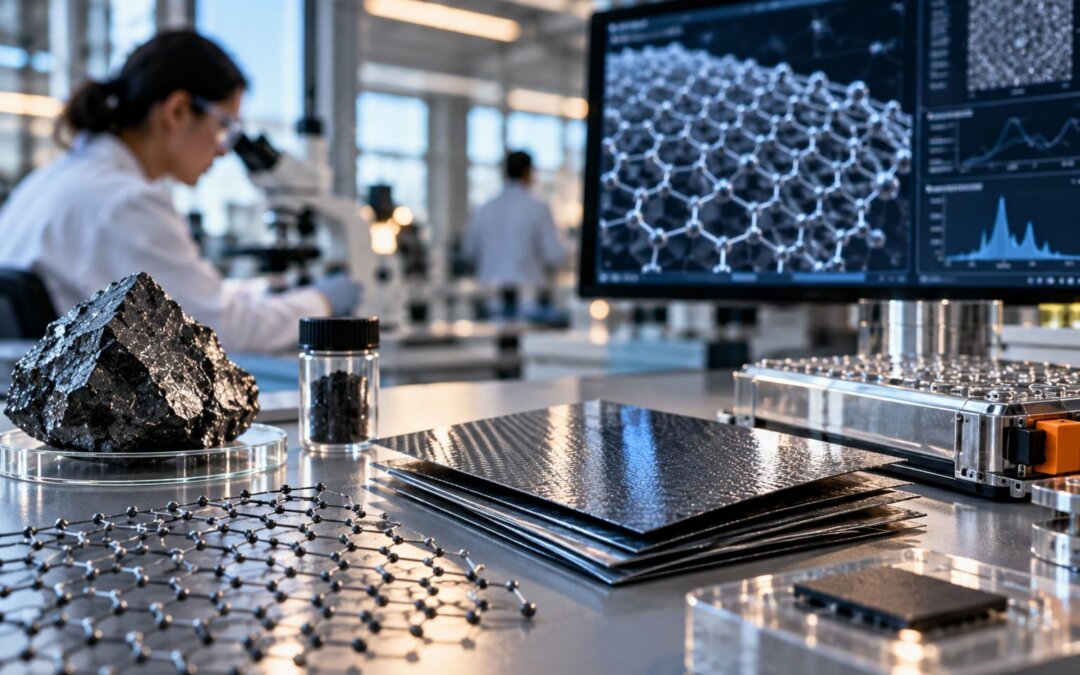
Artificial intelligence receives enormous attention because its effects are visible.
People can interact with a new AI model immediately.
They can ask questions, generate images or write software and see the result in seconds.
Materials science works differently.
A new material might spend years inside a laboratory before appearing in a battery, semiconductor, sensor or aircraft.
The progress is quieter.
But nearly every major technological revolution eventually depends on materials.
Artificial intelligence itself is no exception.
The next generation of AI chips, batteries, sensors, energy systems and quantum computers will all require physical materials capable of doing things today’s materials cannot do efficiently.
That makes advanced materials one of the most important technologies operating behind the scenes.
Every Technology Has a Material Limit
Software can improve rapidly.
Physical systems eventually encounter limits.
A processor can only become so small before electrical and thermal problems become difficult to manage.
A battery can only store so much energy using a particular chemistry.
A sensor needs materials capable of responding to extremely small changes in its environment.
A quantum processor may require superconducting materials with unusual physical properties.
In each case, progress depends partly on discovering or engineering better materials.
The semiconductor industry provides one of the clearest examples.
Silicon has powered computing for decades.
But as devices become smaller, researchers are exploring materials only a few atoms thick.
Nature Materials and related journals have reported significant 2026 progress involving two-dimensional semiconductors, including wafer-scale approaches and new methods of controlling their electrical behavior.
These materials could eventually complement silicon in areas where conventional transistor scaling becomes difficult.
Two-Dimensional Materials Create New Possibilities
Graphene made two-dimensional materials famous.
It consists of carbon atoms arranged in a layer only one atom thick.
Graphene has remarkable electrical, thermal and mechanical properties.
But it is not the only two-dimensional material.
Researchers are studying molybdenum disulfide, tungsten compounds, MXenes, two-dimensional superconductors and numerous other systems.
Each material has different characteristics.
Some behave as semiconductors.
Others conduct electricity unusually well.
Some exhibit magnetic properties.
Others could be useful in optical or quantum devices.
Research published throughout 2026 has demonstrated new two-dimensional superconductors, semiconductors and optoelectronic systems.
The important point is not that one material will replace everything we use today.
It is that engineers are developing a much larger toolbox.
AI Itself Needs Better Materials
Artificial intelligence has dramatically increased demand for computing.
That creates two material problems.
The first is electrical.
Advanced processors need to move enormous amounts of information quickly.
Traditional metal interconnects become more difficult to scale as chips become denser.
Researchers are therefore exploring graphene and other advanced materials for connections inside future chips.
The second problem is heat.
AI processors consume large amounts of electricity, and much of that energy ultimately becomes heat.
Cooling data centers is becoming a major engineering challenge.
Materials that conduct heat efficiently could improve chip packaging, cooling systems and overall energy efficiency.
The AI revolution therefore depends partly on technologies that receive far less public attention than AI models themselves.
Energy Storage Is Another Materials Problem
Battery performance is fundamentally determined by materials.
The cathode, anode, electrolyte and separator all influence how much energy a battery can store, how quickly it can charge, how long it lasts and how safely it operates.
Improving those materials can produce significant changes in performance.
Researchers are exploring silicon-rich anodes, lithium-metal batteries, solid electrolytes, sodium-ion systems and graphene-enhanced electrodes.
No single approach has solved every problem.
Higher energy density can introduce stability problems.
Faster charging can reduce battery life.
New materials can be expensive or difficult to manufacture.
Materials science is often a process of balancing competing properties.
Sensors Are Becoming More Sophisticated
Advanced materials are also changing what sensors can detect.
A sensor operates by responding to some physical or chemical change.
The better the material interacts with its environment, the more sensitive the sensor can become.
Graphene is particularly interesting because nearly every atom exists at the surface.
Changes in the surrounding environment can therefore produce measurable electrical effects.
In March 2026, researchers demonstrated a self-powered sensing platform combining graphene chemical sensors, molybdenum disulfide logic circuits and silicon photovoltaic cells. The device could detect a range of chemical and biological substances while powering itself from ambient light.
That is an interesting example of several materials performing specialized roles inside one system.
The graphene performs sensing.
The two-dimensional semiconductor processes information.
The silicon provides power.
The future may depend increasingly on these kinds of hybrid systems.
Manufacturing Determines Whether Materials Matter
Discovering a remarkable material is only the beginning.
It must also be manufactured reliably and affordably.
Graphene illustrates the challenge.
Its unusual properties have been understood for years.
The difficult part has been manufacturing consistent material at the right quality and cost for different applications.
A July 2026 review of the graphene industry concluded that progress in production and processing is increasingly moving graphene from laboratory research toward commercially viable industrial applications.
This is important.
A material does not need to be perfect.
It needs to perform better than the existing alternative at a price industry can justify.
Many technologies fail that test even after impressive laboratory demonstrations.
AI Could Accelerate Materials Discovery
There is also an interesting relationship between advanced materials and artificial intelligence.
AI needs better materials.
AI may also help discover them.
Materials science involves an enormous number of possible chemical structures and combinations.
Testing them experimentally can be slow and expensive.
Machine learning can help researchers predict which candidates are most promising before manufacturing them.
That could reduce the number of experiments required.
The relationship becomes circular.
Better materials improve computers.
Better computers improve AI.
AI helps researchers discover better materials.
Those materials then create another generation of computing and energy systems.
The Quiet Technology Revolution
Artificial intelligence deserves much of the attention it receives.
It is already changing software, business and science.
But digital technology ultimately operates in the physical world.
A model cannot run without a processor.
A processor cannot function without carefully engineered materials.
An electric vehicle cannot travel without a battery.
A wearable device cannot understand the body without sensors.
A quantum computer cannot operate without materials capable of maintaining unusual physical states.
Advanced materials rarely receive the same attention as the products they make possible.
That does not make them less important.
The next major technological breakthrough may appear to come from artificial intelligence, energy or computing.
Behind it, there is a good chance that materials science will have made the breakthrough possible.