
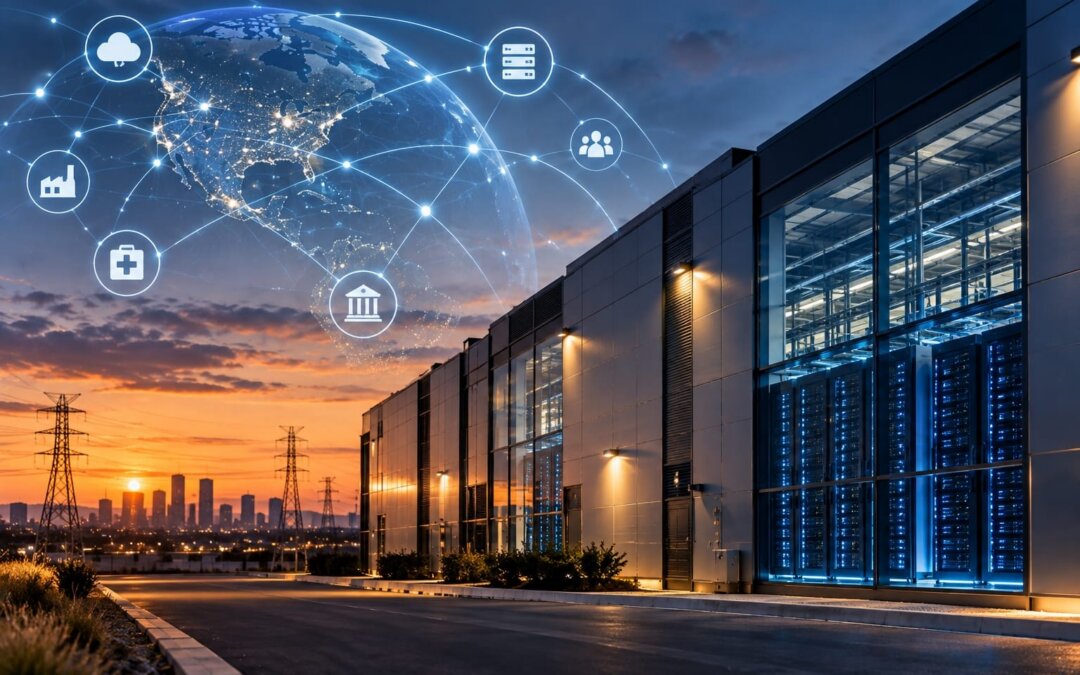
Not long ago, most people rarely thought about data centers.
They were large buildings filled with servers, usually located far from the people actually using the applications running inside them. Unless you worked in technology, telecommunications or real estate, there was little reason to pay much attention to them.
That is beginning to change.
Artificial intelligence, cloud computing, streaming, online banking, digital healthcare and an increasing number of government services all depend on data centers operating continuously.
The growth of AI is making that dependence even more important.
Data centers are no longer simply places where information is stored. They are becoming part of the physical infrastructure that modern economies depend on.
The question is whether we should begin thinking about them in the same category as electricity grids, telecommunications networks, ports and other forms of critical infrastructure.
Computing Has Become Infrastructure
Modern economies run on computing.
A retailer cannot process online orders without it. A bank cannot operate normally without it. Hospitals depend on digital systems. Governments rely on cloud services. Manufacturers increasingly use connected systems to run factories and supply chains.
Much of that computing ultimately takes place inside data centers.
Artificial intelligence adds another layer.
Training and operating advanced AI systems requires enormous amounts of computing capacity. That has triggered one of the largest waves of infrastructure spending the technology industry has ever seen.
Gartner estimates that worldwide information technology spending will reach $6.37 trillion in 2026, with data-center systems and infrastructure services among the fastest-growing areas. The firm has described the effort to build enough computing capacity for AI as the largest infrastructure project ever attempted by humanity.
That description may sound dramatic, but the scale of investment helps explain it.
The International Energy Agency estimates that capital spending by just five major technology companies exceeded $400 billion in 2025 and could rise another 75 percent in 2026, driven largely by data centers and AI infrastructure.
When investment reaches that scale, data centers stop looking like ordinary commercial buildings.
They start looking like strategic infrastructure.
AI Is Changing the Scale
Traditional data centers already consumed significant amounts of electricity.
AI facilities require even more.
The IEA reports that global data-center electricity demand grew 17 percent in 2025, while electricity consumption at AI-focused data centers grew roughly 50 percent.
The physical density of the equipment is also changing.
A modern AI server rack occupies relatively little space, but the amount of electricity passing through it is increasing rapidly. According to the IEA, AI server power density increased elevenfold between 2020 and 2025 and could increase another fourfold by 2027.
That creates challenges far beyond computing.
The building needs more power.
Cooling systems need to remove more heat.
Utilities need larger grid connections.
Manufacturers need to produce more transformers, switchgear and electrical equipment.
The result is that the AI race is increasingly becoming a race for physical infrastructure.
Data Centers and the Grid
Electricity may become one of the biggest limitations on data-center expansion.
Gartner projects worldwide data-center electricity consumption to grow 26 percent in 2026. It expects AI-optimized servers to account for nearly one-third of data-center electricity use this year and potentially surpass conventional server consumption in 2027.
But generating electricity is only part of the problem.
The power must reach the facility.
In the United States, utilities are facing long waits for transformers, circuit breakers and switchgear as data-center developers compete for the same equipment needed for the broader electrical grid. Some high-voltage transformers now have lead times approaching three years.
That creates an unusual situation.
A technology company may be able to design a new AI system very quickly, but the physical infrastructure needed to operate it may take years to build.
Governments are starting to react.
Texas recently paused new state-issued permits for data centers while officials audit their impact on the electrical grid. More than 470 gigawatts of proposed data-center projects were seeking grid connections in the state, several times greater than Texas’ existing peak electricity demand.
Other governments are taking similar steps.
New York has imposed restrictions on some large projects. Amsterdam extended limits on new data-center development. Ireland introduced stricter requirements for new connections, and other jurisdictions are reviewing the effects of large facilities on power, water and local communities.
That is not how governments normally treat ordinary office buildings.
It is how they treat infrastructure.
Security Becomes More Important
Once a piece of infrastructure becomes economically important, protecting it becomes more important too.
Data centers already face cybersecurity threats.
But the physical side deserves just as much attention.
An outage at a facility supporting major cloud services can affect thousands of businesses at once. Damage to electrical infrastructure can interrupt computing services even if the servers themselves remain intact.
The IEA has noted that data centers have already been targeted in conflict zones, underscoring their growing strategic importance.
This raises questions about redundancy.
How much backup power should a facility have?
Should important AI and cloud infrastructure be distributed across multiple regions?
How dependent should a country be on computing capacity located elsewhere?
Governments have been asking similar questions about telecommunications, energy and semiconductor manufacturing for years.
They may increasingly ask them about data centers too.
The Local Debate Will Grow
There is another side to the issue.
Critical infrastructure provides broad benefits, but it also uses resources.
Data centers require land, electricity and, in many cases, significant amounts of water for cooling.
Communities are increasingly asking who should pay for the additional power plants, transmission lines and substations required to serve them.
The European Union recently proposed new rules requiring larger data centers to disclose more information about energy and water efficiency. Data centers currently account for roughly 2.5 percent of EU electricity consumption, and the region plans to significantly expand capacity as it develops more domestic AI infrastructure.
Transparency is likely to become more important as these facilities get larger.
Communities want the jobs and investment associated with technology development.
But they also want to know whether local electricity prices will rise, whether water supplies will be affected and whether taxpayers are subsidizing infrastructure built primarily for private companies.
Those are normal questions when an industry becomes large enough to affect public infrastructure.
Data Centers Could Become Part of the Grid
Interestingly, data centers may not always be only consumers of electricity.
They could eventually help support the grid.
Large facilities increasingly use battery storage to manage fluctuations in power demand. The IEA estimates that data centers could install 20 to 25 gigawatts of battery capacity globally by 2030. With the right systems and incentives, some of that storage could potentially provide flexibility to electrical grids.
Waste heat from data centers can also be reused in some locations.
AI can help operators adjust workloads based on electricity availability.
Facilities could potentially reduce demand during periods of grid stress and increase computing when power is abundant.
That would require cooperation between utilities, regulators and technology companies.
But it suggests that the relationship between data centers and energy systems may eventually become more sophisticated than simply plugging a very large building into the grid.
A Strategic Resource
The internet once felt almost completely virtual.
Artificial intelligence is reminding us how physical computing really is.
AI requires chips.
Those chips require factories.
The servers require buildings.
The buildings require enormous amounts of electricity.
The electricity requires generation, transmission equipment and reliable grids.
That chain is becoming increasingly important to economic competitiveness.
Countries that can provide reliable power, computing capacity, secure infrastructure and favorable locations for data centers may have an advantage as AI continues expanding.
The facilities themselves may also become more heavily regulated, monitored and protected.
Data centers were once viewed mainly as the hidden machinery behind the internet.
They are becoming something different.
They are becoming strategic assets that connect technology, energy, national security and economic development.
That sounds a lot like critical infrastructure.