
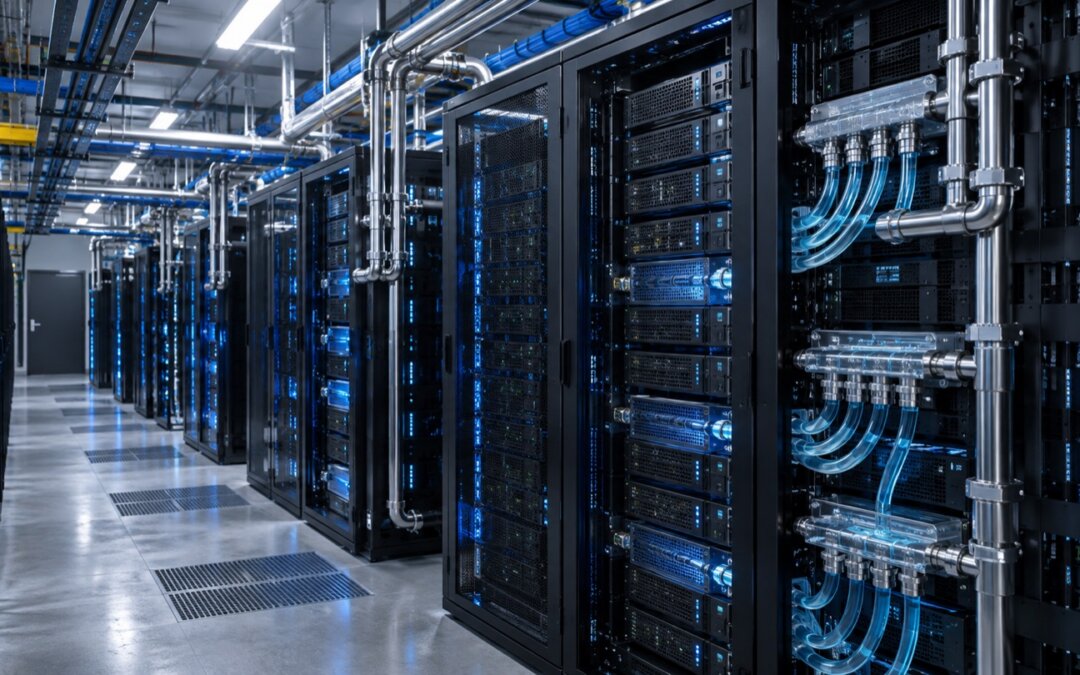
For many years, the basic idea behind a data center was relatively straightforward.
Bring servers together in a secure building, connect them to reliable power and networks, and keep the equipment cool enough to operate.
Those requirements have not gone away. But the way they fit together is changing.
Artificial intelligence and other demanding applications can concentrate more computing power in a smaller space. That changes how a facility is designed, where it can be built and how it works with the electricity system around it.
More Computing in the Same Space
A rack of servers is not simply a collection of processors. It is part of a system that needs electricity, networking, cooling and maintenance.
When more powerful equipment is placed in the same footprint, the amount of heat that must be removed from that area can rise. A cooling design that worked for a room full of less demanding servers may not be the best choice for a concentrated AI workload.
That does not mean every rack in every data center will look the same. Different applications have different needs, and many facilities will continue to support a mixture of equipment.
Cooling Moves Closer to the Hardware
Traditional data centers often use moving air to carry heat away from equipment. Air cooling remains useful, but higher-density systems can also use liquid to move heat away from components or racks.
Liquid cooling is not a single design. Some systems bring coolant close to chips through cold plates; others use heat exchangers near the rack. Each approach has implications for installation, maintenance and the rest of the building.
As the Department of Energy’s data center design guidance makes clear, efficiency depends on the entire system, including how equipment, cooling and electrical infrastructure work together.
There are tradeoffs. A facility must consider water as well as electricity, and a choice that works in one climate or location may not make sense in another.
Power Becomes a Design Constraint
A data center can have an excellent location and a strong network connection, but it still needs a dependable supply of electricity.
That makes conversations with utilities and communities an important part of planning. Developers must consider when power will be available, whether local infrastructure needs to be expanded and how the facility will handle interruptions.
Some workloads may be flexible enough to shift in time. Others need capacity to be available continuously. Understanding the difference can help operators make better decisions about equipment and energy use.
Buildings Designed to Change
Technology rarely stays still for the life of a building. Hardware is replaced, workloads change and new cooling methods may become practical.
A facility designed with room to adapt can be better positioned to accommodate those changes. That may mean planning for different rack densities, reserving space for electrical equipment or using modular components where they make sense.
Flexibility has a cost, however. Building for every imaginable future can leave expensive capacity unused. The challenge is to make informed choices about which changes are likely and which would be difficult to make later.
A Different Kind of Infrastructure Decision
The next generation of data centers will not be defined by one new machine or one cooling technology.
It will be shaped by the relationship between computing, power, water, location and the people who operate the facility. A successful design must serve the workload inside while recognizing the resources and community outside.
That is why a data center is becoming more than a place to put servers. It is an infrastructure decision that can shape the economics and possibilities of the technology it supports.