
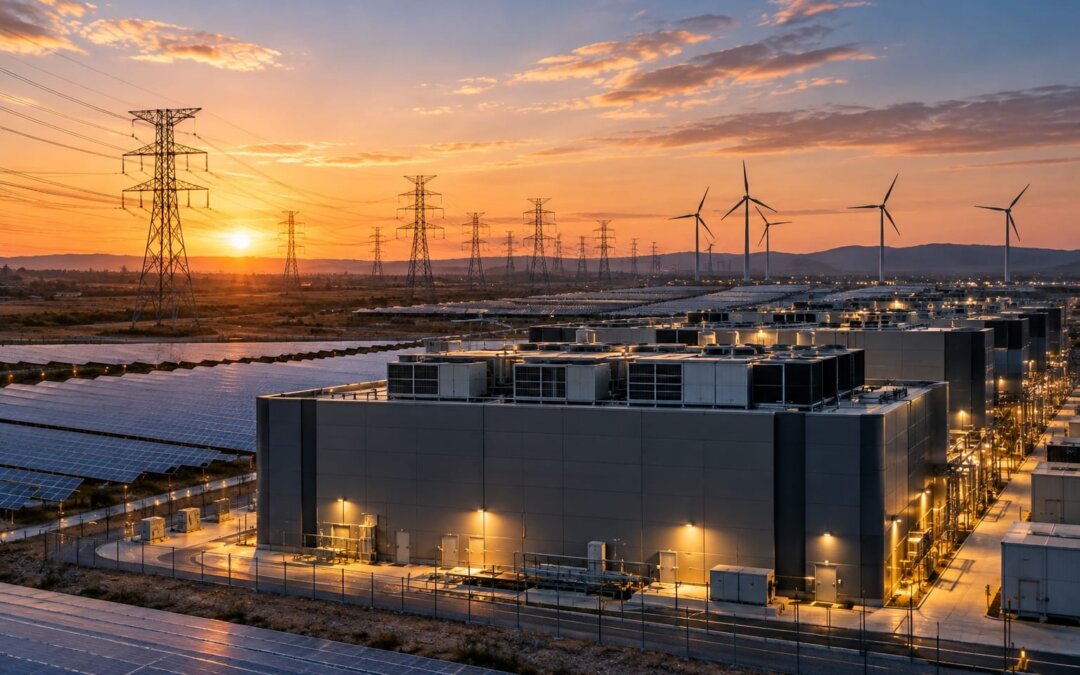
For most of the artificial intelligence boom, the conversation has centered on software.
Which company has the best model? Which chips are the fastest? What jobs will AI change? What new applications will become possible?
Those remain important questions.
But another question is becoming increasingly difficult to ignore: Where will all the electricity come from?
Artificial intelligence is rapidly becoming an infrastructure story as much as a software story. Behind every chatbot, AI agent and image generator sits a collection of servers housed in a data center, and those servers require enormous amounts of electricity, cooling equipment and supporting infrastructure.
As AI systems become more capable and more widely used, access to reliable power may become one of the biggest constraints on how quickly the technology can grow.
AI Has a Physical Footprint
It is easy to think of artificial intelligence as something that exists entirely in the cloud.
The cloud, of course, is physical.
AI models are trained and operated on thousands of specialized processors housed inside data centers. Those processors consume electricity and generate heat, which means they also require cooling systems and additional electrical infrastructure.
The amount of electricity required for a single AI task has actually been falling quickly as chips and software become more efficient.
But that is only part of the equation.
More people are using AI, and the types of tasks being performed are becoming considerably more demanding.
According to the International Energy Agency, simple text-based AI queries have become dramatically more efficient. At the same time, newer uses such as video generation, advanced reasoning and agentic AI can require hundreds or even thousands of times more energy per query than basic text generation.
Efficiency is improving.
Demand is growing even faster.
Data Centers Are Using More Electricity
The numbers help put the scale of the change into perspective.
The IEA estimates that data centers consumed approximately 485 terawatt-hours of electricity globally in 2025. Its current projection has that figure reaching roughly 950 terawatt-hours by 2030. AI-focused data centers are expected to grow considerably faster than conventional facilities.
Globally, that would still represent only around 3 percent of electricity demand.
But the global number can be misleading.
Data centers are concentrated in particular locations. When several large facilities are built in the same region, their effect on the local electrical system can be significant.
A hyperscale AI data center can consume more than 100 megawatts of power. Some of the largest facilities now being planned could require amounts of electricity comparable to those used by entire cities.
That changes the conversation for utilities and governments.
A new software company might be able to launch in months.
A new power plant, transmission line or major grid connection can take years.
The Grid Is Becoming a Bottleneck
Generating enough electricity is only one part of the challenge.
That power must also reach the data center.
Utilities need transformers, substations, transmission lines, switchgear and other equipment capable of handling the load.
Some of that equipment is already in short supply.
In the United States, utilities and data-center developers have been ordering electrical equipment years in advance as AI-related demand increases. Lead times for some high-voltage transformers have stretched beyond three years.
That is a very different constraint from the ones the technology industry is accustomed to dealing with.
Software can scale almost instantly.
Electrical infrastructure cannot.
This mismatch could become one of the defining issues of the AI buildout.
We are already beginning to see governments respond. Texas recently paused certain new state-issued permits for data centers while officials review their impact on the electrical grid. More than 470 gigawatts of proposed data-center projects were reportedly seeking grid connections in the state; several times Texas’ existing peak electricity demand.
The question is no longer simply whether companies want to build AI infrastructure.
It is whether the local power system can support it.
Technology Companies Are Looking for Power
Not surprisingly, the world’s largest technology companies are becoming much more involved in energy.
Some are signing long-term renewable-energy agreements.
Others are investing in nuclear power, battery storage and natural gas generation.
Google recently reached an agreement with Georgia Power to support upgrades at two nuclear plants that would increase electricity output. The additional capacity is partly intended to help satisfy growing demand from data centers and other large power users.
Other regions are positioning themselves as future AI infrastructure hubs partly because they can provide abundant energy.
Alberta, Canada, for example, has attracted major data-center proposals because of its available land, cooler climate and natural-gas resources.
This could eventually influence the geography of the technology industry.
For years, data centers were often located based on factors such as connectivity, tax incentives, land costs and proximity to customers.
Power availability may increasingly move toward the top of that list.
Efficiency Will Not Solve Everything
There is another interesting dynamic at work.
AI chips are becoming more efficient.
Cooling systems are improving.
Software developers are finding ways to achieve the same results using less computation.
Normally, those improvements would suggest lower electricity consumption.
But technology has a long history of producing the opposite outcome.
When computing becomes cheaper and more efficient, people usually find more ways to use it.
AI may follow the same pattern.
Better efficiency could make it economical to add AI to more products, generate more video, deploy more agents and run increasingly complicated models.
So even if every individual task requires less electricity, the total amount of computing could continue growing.
The IEA reported that electricity consumption from AI-focused data centers increased about 50 percent in 2025 alone.
That is why focusing only on efficiency does not tell the entire story.
The Next AI Race May Also Be an Energy Race
Artificial intelligence is often described as a competition for algorithms, talent and semiconductors.
Increasingly, it is also becoming a competition for electricity.
Countries and companies that can provide abundant, reliable and reasonably priced power may have an advantage in building the next generation of AI infrastructure.
That could accelerate investment in renewables, nuclear energy, natural gas, batteries and grid modernization.
It could also create difficult questions about electricity prices, water consumption, environmental impact and who pays for the infrastructure required by enormous new data centers.
The AI boom is therefore beginning to reach far beyond the technology industry.
It is affecting utilities, energy companies, equipment manufacturers, governments and local communities.
The most important limitation on the next generation of artificial intelligence may ultimately have very little to do with software.
It may simply be whether we can produce; and deliver, enough power to run it.